Previous Related Posts:
Smashing Hard Drives ~ The Miranda / Snowden / Guardian Saga Continues
Was Miranda a Mule or a Journalist?
Greenwald Threatens to Spill UK Secrets
UK Detains Greenwald's Partner - Twitter Erupts
Guardian Editor Alan Rusbridger Spins Away
Edward Snowden Releases NSA Secrets
~~~~~~~~~~~~~~~~~~~~~
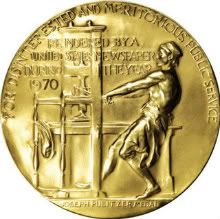
Both the Washington Post and Guardian UK won Pulitzer Prizes for releasing many of the secrets Edward Snowden stole from the United States Government. The award also went to Glenn Greenwald, Laura Poitras, Ewen McAskill and Barton Gellman for their Obama-slamming coverage as Snowden escaped his own country, first to Hong Kong and later Russia. Yeah, that's great. The Pulitzer Committee obviously overlooked the major flaws in the reporting, including contradictions, unfounded fear-mongering, and just pure lies (see previous posts listed above for examples). But that's okay - bad reporters win awards all the time. Have your happy day, but realize that while you may have "started a conversation" about U.S. Spy techniques it remains to be seen if the reporting was actually the "public service" you think it is. Hisory and future actions of spies like Snowden will judge this reporting much more harshly than critics on twitter. Good luck with that.
From Yahoo News
The Guardian and The Washington Post won a prestigious Pulitzer Prize on Monday for reporting on secret US surveillance programs revealed by former National Security Agency contractor Edward Snowden.
The shared award went to the two newspapers credited with breaking the news about NSA surveillance programs, without specifically citing the journalists involved.
The reporters who played key roles in the story included Glenn Greenwald, who has since left the Guardian, and colleague Ewen MacAskill. Barton Gellman, who already has two Pulitzers, was the writer of most of the Washington Post reports.
Laura Poitras, a documentary filmmaker who was the point of contact for Snowden, had the unusual distinction of sharing bylines in both the Guardian and the Post on the topic.
Disclosing the massive expansion of the NSA’s surveillance network absolutely was a public service. In constructing a surveillance system of breathtaking scope and intrusiveness, our government also sharply eroded individual privacy. All of this was done in secret, without public debate, and with clear weaknesses in oversight.”
. . . (Without Snowden) we never would have known how far this country had shifted away from the rights of the individual in favor of state power. There would have been no public debate about the proper balance between privacy and national security. As even the president has acknowledged, this is a conversation we need to have.
~ Martin Baron, Editor of Washington Post
#BREAKINGNEWS: We have won the Pulitzer Prize for public service for our coverage of Snowden's NSA leaks, along with @GuradianUS.
— Washington Post (@washingtonpost) April 14, 2014Lolol obsessed that a #Pulitzer winner misspells name of co-recipient
“@washingtonpost: We have won the Pulitzer...along with @GuradianUS"
— RandiBop (@RandiBop) April 14, 2014Hear @bartongellman on Snowden in his newsroom remarks after the Pulitzer today http://t.co/Nl3J0fWMEm
— Anne Kornblut (@annekornblut) April 15, 2014I have a debt for life to @PostBaron @annekornblut and a list of @washingtonpost colleagues too long to tweet. You know who you are.
— Barton Gellman (@bartongellman) April 14, 2014Awarding the Pulitzer to Snowden enablers is a disgrace
— Rep. Pete King (@RepPeteKing) April 14, 2014.@mattblaze I like the word “enabler.” But @RepPeteKing mistakes the players. Our stories enable the public to hold its leaders accountable.
— Barton Gellman (@bartongellman) April 15, 2014We are truly honoured that our journalism has been recognised with the Pulitzer prize. This was a complex story, written, edited and produced by a team of wonderful journalists. We are particularly grateful for our colleagues across the world who supported the Guardian in circumstances which threatened to stifle our reporting. And we share this honour, not only with our colleagues at the Washington Post, but also with Edward Snowden, who risked so much in the cause of the public service which has today been acknowledged by the award of this prestigious prize.
~ Alan Rusbridger, the editor-in-chief of the Guardian
Today's decision is a vindication for everyone who believes that the public has a role in government. We owe it to the efforts of the brave reporters and their colleagues who kept working in the face of extraordinary intimidation, including the forced destruction of journalistic materials, the inappropriate use of terrorism laws, and so many other means of pressure to get them to stop what the world now recognises was work of vital public importance.
~ Edward Snowden, via Guardian UK
Guardian staff raise toast to Edward Snowden after Pulitzer announced. Editor notes that prize for "public service".
— Ewen MacAskill (@ewenmacaskill) April 14, 2014Public Service Pulitzer Awarded to Greenwald and Poitras for Coverage on #Snowden's NSA Leaks http://t.co/U8UkZG2WoN via @mashable
— Jim Roberts (@nycjim) April 14, 2014Thank you everyone. MT @jonswaine: @arusbridger @stuartmillar159 @janinegibson @laurapoitras and @ewenmacaskill pic.twitter.com/a2unENw65V
— Janine Gibson (@janinegibson) April 14, 2014Laura Poitras and @ewenmacaskill on hearing #pulitzer news in NY office of @GuardianUS pic.twitter.com/DJCqyB9yeE
— alan rusbridger (@arusbridger) April 14, 2014~~~~~~~~~~~~~~~~~~~~~
Edward Snowden didn’t win a Pulitzer on Monday, but he might as well have.
~ Dylan Byers on Politico
The Guardian and Washington Post Don't Deserve Pulitzers Just for Sparking a Debate
. . . if sparking a debate is enough to earn the Pulitzer’s coveted public service medal, then sure. Congrats. I would note, however, that merely sparking a debate is an exceedingly low standard.
There was a time, and it wasn’t very long ago, when this medal meant something more, when “aggressive reporting” meant more than being a vehicle to shovel leaked documents to the public, with stops along the way for obligatory government comment, for fawning characterizations of one’s own sources, and for tendentious claims about what those documents say.
~ Benjamin Wittes on New Republic
Pulitzers don’t make Snowden a hero
. . . It is not the media or the Pulitzer committee that should judge what Snowden did. The main judgment should come from the courts, which are now considering what the government was up to in its collection programs and should also consider what Snowden did. You may think Snowden a whistle-blower, but the only way of knowing whether he is or not is for him to return to the US and face a jury of his peers. He may continue to refuse to do that, and prefer to be sheltered by a government whose behavior he surely knows is at least as bad as that of the one he fled, but that doesn’t make him a hero. It makes him a fugitive.
~ Daniel Serwer on Peacefare.net
Greenwald receiving a Pulitzer is the joke of the year.
— Matt Murphy (@MattMurph24) April 14, 2014Some narcissistic child brings you stolen government secrets & you get a Pulitzer for publishing it. Such deep "journalism" Greenwald lol
— Matt Murphy (@MattMurph24) April 14, 2014So, I wrote a series of error-ridden reports about a legal program & compromised natl security in the process. I can haz my Pulitzer now?
— YeaYouRite (@YeaYouRite) April 14, 2014'Hey, here's some context-less power point slides that look ominous. Pulitzer please'
— Jordan Ashby (@JM_Ashby) April 14, 2014So Pulitzer now rewards thieves. Good to know.
— BWD (@theonlyadult) April 14, 2014
