Showing posts with label guardian. Show all posts

Wednesday, May 28, 2014

Critics Go to War Over "Sourpuss" Glenn Greenwald's Book

 photo 3b9fe8f7-5e66-42be-ad3b-239a44c68ed5.png

Glenn Greenwald's book No Place to Hide was released this week. It's a regular cavalcade of details about the exiled spy - sorry, whistleblower - Edward Snowden, as well as the involvement of authors and Pulitzer winners Greenwald and Laura Poitras, plus the Wikileaks crowd. But Greenwald has run afoul of several book critics, for which he immediately lambasted them for the freedom of speech he says that Snowden is fighting for. Hypocrisy Much?

Critic Wars erupted, and as with all-things-Greenwald, people have to take sides.


Previous Related Posts:
All Hail the Snowden Pulitzer
Was David Miranda a Mule or a Journalist?
Greenwald Threatens to Spill UK Secrets
UK Detains Greenwald's Partner, Twitter Erupts
Define Spy For Us: Greenwald and Snowden
Greenwald Threatens America

~~~~~~~~~~~~~~~~~~~~~

The Guardian, which shared a Pulitzer with Greenwald and Poitras, had a mostly glowing review of the book. But of course they wish he had mentioned their newspaper more in the text because they validated and helped Greenwald when no one else would.

Henry Porter in The Guardian UK
I think the book does a disservice to my colleagues at the Guardian, which after all is established media. The author tips his hat occasionally but does not really acknowledge the importance of the seasoned reporter Ewen MacAskill's work in Hong Kong, or the team that assembled to sift the documents, decode their inner secrets, prioritise information, gain reaction, shape the stories and provide analysis.
It was one of the most impressive journalistic operations I have ever seen and without it Glenn Greenwald would have floundered and, indeed, have been dismissed more easily as an activist journalist. He has done a great job of exposition and advocacy and for that he should be praised, but credit should be shared.

Two reviews in particular seemed problematic for Greenwald mainly because they were NOT glowing and they questioned his motives. Please don't ever do that, reviewers! Criticism should not be critical, but should be left up to experts like Greenwald.

From George Packer in The Prospect
. . . It’s the only account we have by one of the main characters, an ex-litigator for whom prose narrative is another form of political combat.
. . . But the book’s greatest interest lies in what it reveals about dissent and the dissenter in an age when democratic institutions are in disarray. Greenwald and Poitras have a clear political agenda, which is why Snowden, with his deep distrust of the institutional press, chose them.
Greenwald has no use for the norms of journalism. He rejects objectivity, as a reality and an ideal. “‘Objectivity’ means nothing more than reflecting the biases and serving the interests of entrenched Washington,” he writes. “All journalism serves one faction’s interest or another’s.” This is hardly a new notion, but it’s also a destructive one.
. . . Greenwald and Poitras “vowed to each other repeatedly and to Snowden” that their actions would honour Snowden’s choice. So Poitras is outraged when the Guardian violates Snowden’s wishes by sharing his files with the New York Times, as if the Guardian were a vehicle for Snowden’s purposes. And Greenwald attacks the New York Times, which had received thousands of documents from Wikileaks, for highlighting Julian Assange’s troubling behaviour, as if the paper owed its source the benefit of clergy rather than its readers a full picture. Greenwald treats his source as inviolate.
. . . The sense of oppression among Greenwald, Poitras, and other American dissenters is only possible to those who have lived their entire lives under the rule of law and have come to take it for granted.


Excerpts from Now-Infamous and Scathing New York Times Book Review by Michael Kinsley
. . . Greenwald? In his mind, he is not a reformer but a ruthless revolutionary — Robespierre, or Trotsky. The ancien rĂ©gime is corrupt through and through, and he is the man who will topple it.
. . . Greenwald doesn’t seem to realize that every piece of evidence he musters demonstrating that people agree with him undermines his own argument that “the authorities” brook no dissent. No one is stopping people from criticizing the government or supporting Greenwald in any way.
. . . What kind of poor excuse for an authoritarian society are we building in which a Glenn Greenwald, proud enemy of conformity and government oppression, can freely promote this book in all media and sell thousands of copies at airport bookstores surrounded by Homeland Security officers?
. . . private companies that own newspapers, and their employees, should not have the final say over the release of government secrets, and a free pass to make them public with no legal consequences. In a democracy (which, pace Greenwald, we still are), that decision must ultimately be made by the government.
. . . Someone gets to decide, and that someone cannot be Glenn Greenwald.
. . . So what do we do about leaks of government information? Lock up the perpetrators or give them the Pulitzer Prize? (The Pulitzer people chose the second option.) This is not a straightforward or easy question. But I can’t see how we can have a policy that authorizes newspapers and reporters to chase down and publish any national security leaks they can find. This isn’t Easter and these are not eggs.


Greenwald took umbrage with both Packer and Kinsley and wrote a scathing rebuttal - how can these reviewers be against him? How? They must be political tools for Obama:

Glenn Greenwald in The Intercept
. . . in a totally unpredictable development, Kinsley then used the opportunity to announce his contempt for me, for the NSA reporting I’ve done, and, in passing, for the book he was ostensibly reviewing.
. . . Kinsley dutifully tells Times readers that I “come across as so unpleasant” and that I’m a “self-righteous sourpuss” (yes, he actually wrote that). I also describe in the book how jingoistic media courtiers attack anyone who voices any fundamental critiques of American political culture; Kinsley spends much of his review deriding the notion that there could possibly be anything anti-democratic or oppressive about the United States of America.
. . . Reviews of No Place to Hide internationally (the book has been published in more than two dozen countries, in nine languages) have, almost unanimously, been extremely positive. By stark contrast, reviews from American writers have been quite mixed, with some recent ones, including from George Packer and now Kinsley, attempting to savage both the book and me personally.
. . . Do I need to continue to participate in the debate over whether many U.S. journalists are pitifully obeisant to the U.S. government? Did they not just resolve that debate for me?


Margaret Sullivan, Public Editor for the New York Times, agreed with Greenwald and published a rebuttal of Kinsley
. . . Here’s my take: Book reviews are opinion pieces and — thanks to the principles of the First Amendment — Mr. Kinsley is certainly entitled to freely air his views. But there’s a lot about this piece that is unworthy of the Book Review’s high standards, the sneering tone about Mr. Greenwald, for example; he is called a “go-between” instead of a journalist and is described as a “self-righteous sourpuss.” (I’ve never met Mr. Greenwald, though I’ve written about his work, as Mr. Kinsley notes.)
But worse, Mr. Kinsley’s central argument ignores important tenets of American governance. There clearly is a special role for the press in America’s democracy; the Founders explicitly intended the press to be a crucial check on the power of the federal government, and the United States courts have consistently backed up that role. It’s wrong to deny that role, and editors should not have allowed such a denial to stand. Mr. Kinsley’s argument is particularly strange to see advanced in the paper that heroically published the Pentagon Papers, and many of the Snowden revelations as well. What if his views were taken to their logical conclusion?


After her own motives (and sympathies for Greenwald/Snowden) were questioned on Twitter and in the NYT comment section, Ms. Sullivan rolled back her criticism of the critic somewhat.
I think there is no reason in this case to distrust Mr. Kinsley or to suspect that he did not read the book, digest its material and write a review based on his own judgment. As part of our editorial process, we made sure that Mr. Kinsley’s characterization of the work was backed up by material in the book itself. By that standard, the review was certainly fair and accurate.
To take on but one specific criticism of the review: At no point did Mr. Kinsley call Mr. Greenwald a sourpuss. The actual text reads as follows: “Maybe he’s charming and generous in real life. But in ‘No Place to Hide,’ Greenwald seems like a self-righteous sourpuss, convinced that every issue is ‘straightforward,’ and if you don’t agree with him, you’re part of something he calls ‘the authorities,’ who control everything for their own nefarious but never explained purposes.” For a reviewer to address how a writer comes across, particularly in a memoir or first-hand account, is entirely fair game for a book review, and by no means an ad hominem attack.

More critiquing the critics and their critics:

The Tone and Thought Police at the New York Times
Kinsley, truth to tell, is unkind to Snowden, and that is where the trouble begins. Sullivan thinks Kinsley’s “sneering tone” is “unworthy of the Book Review’s high standards.” Kinsley says, among other things, that Greenwald, whatever he may really be like, comes across as a “self-righteous sourpuss” in the book. Never mind that the New York Times would not have an op-ed section if sneering were ruled out of bounds. Although Kinsley gives us Greenwald’s own words to back up his assertion, it is too much for Sullivan, who apparently thinks that Kinsley should have found a way to indicate that Greenwald’s authorial voice is that of a self-aggrandizing blowhard without being insulting.
. . . Here, then, are the standards the public editor of the New York Times applies in investigating “matters of journalistic integrity” in the book review section.
. . . Reviewers who express views that, however plausible, are considered out of bounds by Times staff should be compelled to recant if they wish to get published.
~ Jonathan Marks in Commentary

Greenwald's haters, exposed
. . . both Kinsley and Packer at least give lip service to the idea that what Greenwald and Snowden have revealed is valuable and troubling. But in their predictable desire to distance themselves from the kind of fundamental and, yes, radical attack put forward by the NSA leakers, Kinsley and Packer are defending the national security state as flawed rather than corrupt, in need of reform rather than reconstruction. And if you think that sounds crazy, maybe you’re another Robespierre or Trotsky, too.
~ Elias Isquith on Salon

I predict that Packer's attitude toward Snowden will one day seem as absurd as someone insisting that MLK would be worthy of condemnation if he hadn't gone to jail, or that the activists who stole FBI files proving improper spying ultimately harmed the rule of law by never turning themselves in.
Like Michael Kinsley, another moderate liberal journalist who made dubious claims in a review of Greenwald's book, something about Packer's relationship to the establishment causes him to understate the radicalism of the international security state and to overstate the radicalism of its critics.
~ Conor Friedersdorf on The Atlantic

Monday, April 14, 2014

All Hail The Snowden Pulitzer


Previous Related Posts:
Smashing Hard Drives ~ The Miranda / Snowden / Guardian Saga Continues
Was Miranda a Mule or a Journalist?
Greenwald Threatens to Spill UK Secrets
UK Detains Greenwald's Partner - Twitter Erupts
Guardian Editor Alan Rusbridger Spins Away
Edward Snowden Releases NSA Secrets

~~~~~~~~~~~~~~~~~~~~~

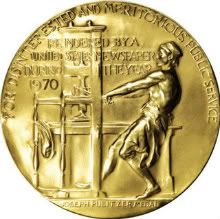
Both the Washington Post and Guardian UK won Pulitzer Prizes for releasing many of the secrets Edward Snowden stole from the United States Government. The award also went to Glenn Greenwald, Laura Poitras, Ewen McAskill and Barton Gellman for their Obama-slamming coverage as Snowden escaped his own country, first to Hong Kong and later Russia. Yeah, that's great. The Pulitzer Committee obviously overlooked the major flaws in the reporting, including contradictions, unfounded fear-mongering, and just pure lies (see previous posts listed above for examples). But that's okay - bad reporters win awards all the time. Have your happy day, but realize that while you may have "started a conversation" about U.S. Spy techniques it remains to be seen if the reporting was actually the "public service" you think it is. Hisory and future actions of spies like Snowden will judge this reporting much more harshly than critics on twitter. Good luck with that.


From Yahoo News
The Guardian and The Washington Post won a prestigious Pulitzer Prize on Monday for reporting on secret US surveillance programs revealed by former National Security Agency contractor Edward Snowden.
The shared award went to the two newspapers credited with breaking the news about NSA surveillance programs, without specifically citing the journalists involved.
The reporters who played key roles in the story included Glenn Greenwald, who has since left the Guardian, and colleague Ewen MacAskill. Barton Gellman, who already has two Pulitzers, was the writer of most of the Washington Post reports.
Laura Poitras, a documentary filmmaker who was the point of contact for Snowden, had the unusual distinction of sharing bylines in both the Guardian and the Post on the topic.

Disclosing the massive expansion of the NSA’s surveillance network absolutely was a public service. In constructing a surveillance system of breathtaking scope and intrusiveness, our government also sharply eroded individual privacy. All of this was done in secret, without public debate, and with clear weaknesses in oversight.”
. . . (Without Snowden) we never would have known how far this country had shifted away from the rights of the individual in favor of state power. There would have been no public debate about the proper balance between privacy and national security. As even the president has acknowledged, this is a conversation we need to have.
~ Martin Baron, Editor of Washington Post


We are truly honoured that our journalism has been recognised with the Pulitzer prize. This was a complex story, written, edited and produced by a team of wonderful journalists. We are particularly grateful for our colleagues across the world who supported the Guardian in circumstances which threatened to stifle our reporting. And we share this honour, not only with our colleagues at the Washington Post, but also with Edward Snowden, who risked so much in the cause of the public service which has today been acknowledged by the award of this prestigious prize.
~ Alan Rusbridger, the editor-in-chief of the Guardian

Today's decision is a vindication for everyone who believes that the public has a role in government. We owe it to the efforts of the brave reporters and their colleagues who kept working in the face of extraordinary intimidation, including the forced destruction of journalistic materials, the inappropriate use of terrorism laws, and so many other means of pressure to get them to stop what the world now recognises was work of vital public importance.
~ Edward Snowden, via Guardian UK


~~~~~~~~~~~~~~~~~~~~~

Edward Snowden didn’t win a Pulitzer on Monday, but he might as well have.
~ Dylan Byers on Politico

The Guardian and Washington Post Don't Deserve Pulitzers Just for Sparking a Debate
. . . if sparking a debate is enough to earn the Pulitzer’s coveted public service medal, then sure. Congrats. I would note, however, that merely sparking a debate is an exceedingly low standard.
There was a time, and it wasn’t very long ago, when this medal meant something more, when “aggressive reporting” meant more than being a vehicle to shovel leaked documents to the public, with stops along the way for obligatory government comment, for fawning characterizations of one’s own sources, and for tendentious claims about what those documents say.
~ Benjamin Wittes on New Republic

Pulitzers don’t make Snowden a hero
. . . It is not the media or the Pulitzer committee that should judge what Snowden did. The main judgment should come from the courts, which are now considering what the government was up to in its collection programs and should also consider what Snowden did. You may think Snowden a whistle-blower, but the only way of knowing whether he is or not is for him to return to the US and face a jury of his peers. He may continue to refuse to do that, and prefer to be sheltered by a government whose behavior he surely knows is at least as bad as that of the one he fled, but that doesn’t make him a hero. It makes him a fugitive.
~ Daniel Serwer on Peacefare.net


Friday, August 23, 2013

Was Miranda a "Mule" or a Journalist?

 photo 6ecd5972-5762-4230-a7cd-755bf8ced42a.jpg

Previous Related Posts:
Guardian Editor Alan Rusbridger Spins Away
Smashing Hard Drives: the Miranda - Snowden - Guardian Saga Continues
Glenn Greenwald Threatens to spill UK Secrets
UK Detains Greenwald's Partner, Twitter Wars Erupt

~~~~~~~~~~~~~~~~~~~~~

I was just taking materials back to Glenn.
~ David Miranda, spouse of journalist Glenn Greenwald, on CNN after being stopped and held for nine hours at Heathrow Airport while possibly carrying material from fugitive Edward Snowden


What is the Guardian's Position over David Miranda's Legal Action?
Alan Rusbridger, Editor, Guardian UK: The Guardian is supporting that action and we are supporting it in terms of financing it because David Miranda was acting on behalf of Glenn Greenwald at the time he was detained. So we support that action and I think it's a good thing to challenge that law and see why Terror and Journalism are being elided in this disturbing way.
David Miranda wasn't really "on assignment." He is Glenn Greenwald's partner. Glenn Greenwald's a very busy man and he assists Glenn in his journalistic work, and he was acting as a messenger or intermediary in a way that's difficult for Glenn at the moment because he's got a lot of work to be doing in Brazil, and I think he's also a bit nervous about traveling at the moment.
Was it wrong for the Guardian to pay a non-journalist to act as a courier this way, especially if he didn't know what he was carrying?
Rusbridger: Glenn Greenwald trusts David - he obviously does as his partner, and it was Glenn's decision and David's -- he's a grown-up adult. He wanted somebody he could trust and ... it was important that Glenn had somebody he could trust.
~ Complete Interview Transcript with Alan Rusbridger of Guardian Here

It sounds a lot like he’s being used by Greenwald and doesn’t fully understand the seriousness of what he’s wrapped up in. Now, like any other adult Miranda has agency and did not have the make the trip. And it’s possible he’s downplaying his role to sound innocent.
~ Joshua Foust

In short, the Brazilian was acting as a sort of ‘mule’, though Guardian reports have ignored or under-played this. The Tory MP David Davis, who has bravely campaigned against state surveillance, pointed out yesterday that whatever material was taken from Mr Miranda probably exists elsewhere.
But can you blame the British police for wishing to seize it?
By the way, Mr Miranda acted idiotically in coming via London on his way to Rio de Janeiro, as it is the one place in the world other than America where police were likely to take an interest in him.
~ Stephen Glover on The Daily Mail

Greenwald himself has previously told journalists that his partner assists him in his work. That present ‘work’ consists of engineering the leak of massive amounts of classified intelligence from a source – Edward Snowden – currently granted asylum in Moscow. Greenwald’s partner was travelling through London from a meeting using plane-tickets paid for by the Guardian and – it now transpires – appears to have been carrying files from Snowden. So all those ‘this could happen to any of us’ pieces are only really relevant if you happen to use your partner as a mule for industrial-scale sabotage against states you’re planning to travel to.
~ Douglas Murray on The Spectator

CNN Transcript: Anderson Cooper 360 Degrees, Aired August 20, 2013 - 20:00 ET
JEFFREY TOOBIN, CNN SENIOR LEGAL ANALYST: I sure do. Let's be clear about what Mr. Miranda's role was here. I don't want to be unkind but he was a mule. He was given something, he didn't know what it was, from one person to pass to another at the other end of an airport. Our prisons are full of drug mules.
Glenn's view is, as long as one of the two people on either end of that transaction was a journalist, he can take anything he wants. He could take the nuclear launch codes, he could take the names of our undercover agents --

COOPER: His flight was paid for by "The Guardian," though, so wasn't it in effect he acting in a journalistic capacity?

TOOBIN: No. I don't think that matters a bit who pays for your ticket. I mean, he's on a plane with stuff that is highly classified. You know -- anything he wants, it turns out it wasn't the names of our undercover agents, it was the extremely classified presumably NSA material. That is not the law.

COOPER: But does it -- I mean, he is being detained under a British -- UK Terrorism Act which is -- only supposed to be used to detect and find people who are connected to terrorist. There is no indication that David Miranda -- they knew who he was, they knew he's not connected to some terrorist group.

TOOBIN: Great Britain has its own laws that are similar to ours but then are somewhat different. Their terrorism law takes it one step farther. They say, it's not just the material -- this person is a terrorist, but can be used by terrorist. And frankly, if terrorist know how we surveil their cell phone calls, how we surveil their texts, that could be used for terrorism.
. . . Mr. Miranda was lucky that they used the terrorism law because he wasn't even delayed. He wasn't even stopped overnight. I mean, you know, I'm sure it was inconvenient to be stopped for nine hours at the airport, but, you know, when it -- but you know, when it happens to you on JetBlue they don't even offer you a lawyer.

So, I mean, I just don't think he was sent to the gulag. He was -- he was delayed for a while and they took what appears to be stolen classified information. I think Mr. Miranda actually did pretty well, considering what he was carrying.

. . . The word journalism is not magical immunity sauce that you can put on anything --
COOPER: Immunity sauce --
(LAUGHTER)
TOOBIN: That you can put on anything and make -- eliminate any sort of liability. You know what? If he had the nuclear launch codes on there, he could -- you know, they can take that. If he had the names of undercover operatives, they can take that.

~~~~~~~~~~~~~~~~~~~~~~

Miranda states (if you believe him, and I don’t) that he had no idea what he was carrying. Greenwald states that he was transporting Snowden’s stolen, top secret CIA intelligence data on encrypted thumb drives. So basically, you have Greenwald using his spouse as a mule to actively assist Edward Snowden, and you have Miranda apparently lying at the airport when he answers that damned basic security question… “Has anyone given you anything to carry on board?”
Did you lie to airport security, then, David?
~ Louise Mensch on The Telegraph


Ask yourselves if Glenn Greenwald, and Laura Poitras, are actively assisting Edward Snowden in his treacherous dissemination of classified, incredibly sensitive US and UK intelligence? From where I’m sitting, it looks like an attempt to fight charges in advance – by claiming that they are journalists and everything they do is covered by the First Amendment. Hence the New York Times putting Poitras on the cover of its magazine supplement this week and Greenwald’s repeated lies about the role of his husband and the events and aftermath of the detention to British journalists, unchallenged anywhere in the UK press, until I started tweeting about it & wrote my last blog on the topic.
They hope that claiming a journalistic role will protect them when they are stealing, storing and disseminating classified intel about not just NSA snooping but America’s intelligence programmes against China, Russia and so forth. They are, in doing so, risking countless lives. So are the Guardian newspaper.
Louise Mensch on Unfashionista


Tuesday, August 20, 2013

Guardian Editor Alan Rusbridger Spins Away

 photo Spinning.gif

Previous Related Posts:
Smashing Hard Drives: the Miranda - Snowden - Guardian Saga Continues
Glenn Greenwald Threatens to spill UK Secrets
UK Detains Greenwald's Partner, Twitter Wars Erupt

~~~~~~~~~~~~~~~~~~~~~

Note: In my previous post called Smashing Hard Drives  Editor Alan Rusbridger of the Guardian UK was quoted in his own paper saying that an unnamed "shadowy government group" came storming in and destroyed computers in the basement of the building. However, in an interview today with BBC Radio 4, he said Guardian "destroyed the material ourselves." In fact he said it to BBC, then says it twice in an interview posted on the Guardian website. Which version is true, yesterday's or today's? Are they victims of Government overreach or is this just Spin to get sympathy for Snowden?How much credibility can Guardian have going forward when they post hyperbole with incredible details one day, then roll it back the next day? And the reasons for holding onto this story for a month are rather lame - see Huff Post story below. Also Rusbridger also uses an incredibly tone-deaf phrase when he says that Snowden is "waving a red flag" at the world given the history of both China and Russia. #Derp
~ SnarkAmendment

~~~~~~~~~~~~~~~~~~~~~~

Guardian Editor Alan Rushbridger Interviewed by BBC Radio
Rusbridger told BBC Radio 4's The World at One on Tuesday that he agreed to the "slightly pointless" task of destroying the devices – which was overseen by two GCHQ officials at the Guardian's headquarters in London – because the newspaper is in possession of digital copies outside Britain.

. . . "It was a rather bizarre situation in which I explained to them that there were other copies and, as with WikiLeaks, we weren't working in London alone so destroying a copy in London seemed to me a slightly pointless task that didn't take account of the way that digital information works these days," said Rusbridger.

"Given that there were other copies and we could work out of America, which has better laws to protect journalists, I saw no reason not to destroy this material ourselves rather than hand it back to the government."

Rusbridger added that the alternative to destroying the computer hard drives would be "essentially surrendering control of that material" to the courts while fighting a lengthy legal case with only a small prospect of winning.

"It seemed to me fruitless to go through that exercise of fighting that case, which would have meant that we could not write about the Snowden material when there were other copies. So it's simply a matter of transferring our reporting to America," he told The World at One's Martha Kearney.

~~~~~~~~~~~~~~~~~~~~~

From Huffington Post
Rusbridger told The Huffington Post that he could not originally discuss the property destruction, which took place July 20 before two security experts from British spy agency GCHQ, for “operational reasons."

“Having been through this and not written about it on the day for operational reasons, I was sort of waiting for a moment when the government’s attitude to journalism –- when there was an issue that made this relevant,” Rusbridger said.

That moment came after Sunday's nine-hour airport detainment of David Miranda, partner of Glenn Greenwald, the Guardian journalist at the center of the NSA surveillance story.

“The fact that David Miranda had been detained under this slightly obscure schedule of the terrorism act seemed a useful moment to write about the background to the government’s attitude to this in general,” Rusbridger said.


~~~~~~~~~~~~~~~~~~~~~


Guardian Video about Smashed Computers, Miranda, and Snowden


From the Video ~ (My Transcript)

Rusbridger: The disturbing thing about the way they treated David Miranda was the use of this "Terror Act." And there's a little noticed section, schedule 7, which effectively suspends all the normal checks and balances which you would have if you were arrested in Heathrow car park. So in mainland Britain if you're carrying journalistic material you have checks and balances, you can go before a judge, you can argue about the public interest and public importance of that work. By doing it in this kind of stateless bit of Britain, a port or an airport transit lounge and calling it terror, they suspend all the normal rules. And I think that is why people have got disturbed by what happened on Sunday.
We've just seen Edward Snowden holed up in Moscow transit lounge, and I think there's a confusion in law as to where you are when you're in a transit lounge or whether ... whose laws are applied to you.
The British Government about 12-13 years ago actually created this "lawless bit of Britain" where anybody can be questioned for up to nine hours without access to a solicitor, and where all your belongings can be confiscated. And there's nothing you can do about it.
(Note: Guardian reported yesterday that David Miranda was offered a solicitor but refused.)

What is the Guardian's Position over David Miranda's Legal Action?
Rusbridger: The Guardian is supporting that action and we are supporting it in terms of financing it because David Miranda was acting on behalf of Glenn Greenwald at the time he was detained. So we support that action and I think it's a good thing to challenge that law and see why Terror and Journalism are being elided in this disturbing way.
David Miranda wasn't really "on assignment." He is Glenn Greenwald's partner. Glenn Greenwald's a very busy man and he assists Glenn in his journalistic work, and he was acting as a messenger or intermediary in a way that's difficult for Glenn at the moment because he's got a lot of work to be doing in Brazil, and I think he's also a bit nervous about traveling at the moment.

Was it wrong for the Guardian to pay a non-journalist to act as a courier this way, especially if he didn't know what he was carrying?
Rusbridger: Glenn Greenwald trusts David - he obviously does as his partner, and it was Glenn's decision and David's -- he's a grown-up adult. He wanted somebody he could trust and ... it was important that Glenn had somebody he could trust.

Why did you take the decision to destroy the files you had in your possession?
Rusbridger: We were faced effectively with an ultimatum from the British Government that if we didn't hand back the material or destroy it they would move to law. That would mean prior restraint, a concept that is anathema in America and in other parts of the world, in which the state can effectively prevent a news publisher from publishing. And I didn't want to get into that position. And I also explained to the UK officials that we were dealing with that there were other copies already in America and Brazil so they wouldn't be achieving anything.
But once it was obvious that they would be going to law, I would rather destroy the copy than hand it back to them, or allow courts to freeze our reporting.


Would handing over the material be seen as a betrayal of Edward Snowden?
Rusbridger: Well, I didn't think we had Snowden's consent to hand the material back, and I didn't want to help the UK authorities know what he had given us.
So, to me, I wasn't going to hand it back to the government and I was happy to destroy it because it was not going to inhibit our reporting. We would simply do it from America and not from London.

In what way did the Government put pressure on you?
Rusbridger: I think the Government were geniuinly torn and to begin with they were not heavy handed. They were reasonable conversations. It was a reasonable dialogue. All I can is that at some point something changed and that switched into a threat of legal action. I don't know what changed or why they changed. I imagine there were different conversations going on within the security apparatus, within Whitehall, within Downing Street, and at some point a message came to me that 'we'd had our fun' and that the time had now come to return the documents.

How do you think this whole episode will affect the way Journalists go about their work?
Rusbridger: I think anybody, any journalist, reading the Snowden revelations ought to realize that with the mass collection of millions and millions of emails, details of phone calls, texts, the business of reporting securely and having confidential sources is becoming difficult. And I think our further revelations will underline that. I mean, obviously this is a much bigger subject than just journalism. And it affects every citizen. But journalists, I think, should be aware of the difficulties they're going to face in the future because everybody in 2013 leaves a really big digital trail which is very easily accessed.
I hope what this will do is lead people back to read the stories that so upset them about the British state. There's been a lot of reporting about what GCHQ and the NSA are up to. And I think what Snowden is trying to draw attention to is the degree in which we are on a road to total surveillance. We're not there yet, but in these documents there is the state ambition to scoop up everything and store it all and to master the internet.
This is a language that's being used internally and Snowden essentially risked his freedom to wave a big red flag and say look, this is the infrastructure they're building.
And I think in America and in Europe (England?), countries (sp) which have recent history of what that counter-surveillance means, this is being taken very very seriously, and has started a big debate. And I think that the danger in the UK is -- we're a kind of blessed country, we haven't had that kind of recent history. The danger is we'd be a little bit complacent about what's being revealed.

Smashing Hard Drives ~ The Miranda - Snowden - Guardian Saga Continues

 photo computer-hammer.jpg

Previous Related Posts:
Glenn Greenwald Threatens to spill UK Secrets
UK Detains Greenwald's Partner, Twitter Wars Erupt

~~~~~~~~~~~~~~~~~~~~~~

Glenn Greenwald's husband, David Miranda, in Guardian UK
They were threatening me all the time and saying I would be put in jail if I didn't co-operate. They treated me like I was a criminal or someone about to attack the UK … It was exhausting and frustrating, but I knew I wasn't doing anything wrong.
. . . I was in a different country with different laws, in a room with seven agents coming and going who kept asking me questions. I thought anything could happen. I thought I might be detained for a very long time.
They got me to tell them the passwords for my computer and mobile phone. They said I was obliged to answer all their questions and used the words 'prison' and 'station' all the time.
It is clear why they took me. It's because I'm Glenn's partner. Because I went to Berlin. Because Laura lives there. So they think I have a big connection. But I don't have a role. I don't look at documents. I don't even know if it was documents that I was carrying. It could have been for the movie that Laura is working on.

(Miranda) was offered a lawyer and a cup of water, but he refused both because he did not trust the authorities. The questions, he said, were relentless – about Greenwald, Snowden, Poitras and a host of other apparently random subjects.
"They even asked me about the protests in Brazil, why people were unhappy and who I knew in the government," said Miranda.
He got his first drink – from a Coke machine in the corridor – after eight hours and was eventually released almost an hour later. Police records show he had been held from 08.05 to 17.00.
~ Guardian UK


Glenn Greenwald on CNN's Anderson Cooper:

COOPER: I read "The Guardian" had paid for David's flights.
Glenn, was he carrying classified material with him?

GREENWALD: Well, I'm not going to talk about what he was carrying because that's our product as journalists. Remember, both Laura and I are working with "The Guardian" as journalists. What I would say is every single newsroom in the United States, every single major news organization in the world has classified information. Reporting on what governments do in the secret is what journalism is about. So if you want to support the idea that states can just go and confiscate from journalists classified information, you should be demanding that your government go physically into newsrooms and seize whatever classified information is there.

All of the best reporting over the last 40 years involves journalists having classified information, the Pentagon Papers, the Bush torture cites, CIA black sites, the illegal warrantless eavesdropping program. That's what investigative journalism is. And if you want to start criminalizing that, it means that you're asking, as a citizen, to be kept ignorant and to allow people in power to conceal what they're doing behind a wall of secrecy and to have no accountability or transparency.

Journalism is not a crime and it is not terrorism.

COOPER: I would also imagine that any information that David might have had was likely duplicated, backed up some place else. So confiscating it, it's not like that would make it simply disappear, which then, I guess, leads to your argument that this was to intimidate you and send a message to others.

GREENWALD: What they did is ludicrous. First of all, of course we have multiple copies of every single thing that we're working on. Nobody would ever travel with only one copy of anything, even if you just lose it or it's stolen. That would be inane. Of course we have multiple copies around the world in different places. So taking it is in no way accomplishing anything.

Secondly, every single thing that both David and I carry, even personal items, things for his school, are protected by very advanced and heavy forms of encryption, which they can't access. So taking it doesn't enable them to know what's in there, either. It's not going to stop our reporting. It doesn't do them any good.
All it did, as I said this week, is give them a huge black eye in the world, make them look thuggish and authoritarian, interfering in a -- in the journalism process, creating international incidents with the government of Brazil, which is indignant over what was being done, for no benefit at all to themselves, which is why I said I truly believe they'll come to have regret -- to regret what they've done, because it's an -- aside from being oppressive and dangerous, it's also quite incompetent and really quite dumb.

~~~~~~~~~~~~~~~~~~~~


~~~~~~~~~~~~~~~~~~~~~


From Alan Rusbridger, Editor of The Guardian
The mood toughened just over a month ago, when I received a phone call from the centre of government telling me: "You've had your fun. Now we want the stuff back." There followed further meetings with shadowy Whitehall figures. The demand was the same: hand the Snowden material back or destroy it. I explained that we could not research and report on this subject if we complied with this request. The man from Whitehall looked mystified. "You've had your debate. There's no need to write any more.
. . . one of the more bizarre moments in the Guardian's long history occurred – with two GCHQ security experts overseeing the destruction of hard drives in the Guardian's basement just to make sure there was nothing in the mangled bits of metal which could possibly be of any interest to passing Chinese agents. "We can call off the black helicopters," joked one as we swept up the remains of a MacBook Pro.
Whitehall was satisfied, but it felt like a peculiarly pointless piece of symbolism that understood nothing about the digital age. We will continue to do patient, painstaking reporting on the Snowden documents, we just won't do it in London. The seizure of Miranda's laptop, phones, hard drives and camera will similarly have no effect on Greenwald's work.

~~~~~~~~~~~~~~~~~~~~~~~


From the Guardian UK Comments Section:

Ah Bright Wings: Wait...did this really happen? . . .
AlanRusbridger: yes, it really happened...

Shadows88: "Shadowy Whitehall figures"? I can't believe you don't know who you were speaking to. Name names. If you're not legally allowed to, say so. Stop playing the authorities game.
AlanRusbridger: It's not legal. Every journalist sometimes agrees to some things/conversations/names being off the record...
Phineus: Stop playing Wormtongue

AlanC: What worries me most in your piece, Alan, is that you apparently 'handed over' the material when asked to do so rather than force the government to go to court. Recalling the joke a GCHQ operative made after you cravenly gave into their demands can't hide the fact that you failed to stand up to intimidation.
If the Guardian won't stand up for the right what hope do the rest of us have?
Have I misunderstood?
AlanRusbridger: I think you're missing the point. The "destruction" of the hard disc will make no difference to our reporting
AlanC: Sorry, Alan, but I believe that you are the one missing the point. If you meekly give into their demands without insisting that they take you to court then you've as good as admitted that they can do whatever they like as far as the UK press is concerned. Now if you had made that story a front page feature the day after it happened then you might have a point but, as far as I can remember, there was nary a cheep.
AlanRusbridger: Play out the scenario for me in which fighting this case in court would have enabled us to do a better job of reporting the Snowden documents. I'm not sure I quite see it...
AlanC: How would fighting the case in the courts against Government seizure of the hard drives in question have made a jot of difference to the Guardian reporting the Snowden papers? As you correctly say, actual possession of the physical drives was immaterial in this day and age. That you don't seem to have realised that what was done was a serious matter for press freedom and didn't see fit to report it at the time deeply concerns me.
(That said, all credit to you for coming BTL and responding to our concerns)

AdamW: Alan -- what was the context under which the destruction of hard drives on The Guardian premises took place? Did you do it voluntarily? Was there a court order? Please explain.
AlanRusbridger: As described...
AdamW: I'm afraid it's still unclear to me (and others in this comments stream) why you seemingly chose to voluntarily allow GCHQ on to the paper's premises to oversee the destruction of your property instead of fighting them in court.
Whether it was immaterial to continued reporting is not the point. Why allow them in at all? What right did they have to be there?
AlanRusbridger: no
AdamW: Alan, you're starting to speak like them ;)No to what?

lids: Pity you gave in to their intimidation.
AlanRusbridger: think you're missing the point...
surrogate: As others pointed above, it is you who are missing the point, or let's say one of the points. That point is that government officials have pressured you into destroying the materials you were reporting on. It has absolutely no relevance that other copies exist, or that it doesn't impede the Guardian's ability to continue reporting. What if other copies didn't exist? We're talking about the principle here, not about you managing to work around it. To top it all, that episode wasn't even reported in the Guardian, and even now it's mentioned only in passing. Instead you're making fun of the GCHQ not being able to understand the digital age, now that is missing the point, completely. And I can only imagine you're doing it deliberately, you are a journalist and I refuse to believe you don't understand what you're being asked repeatedly in these comments. I can understand that the legal framework is shoddy and possession of those materials could be deemed illegal, but to see you brush over that particular issue is worrying.

Crowfoot: Ok Alan, There's a tide of us ordinary folks out here, shocked witless, cross, affronted by the degree to which basic democratic rights have been usurped, and fully support The Guardian's David stance against Goliath.
But what does one proactively do with one's anger? How can we help? How to galvanise the public's response?
Give us something to do.
AlanRusbridger: Keeping readin the Guardian... and I suppose you could support Snowden's defence fund

WhyDidHessFly: A good, thoughtful, piece. Somewhat spoilt by the narcissistic preamble about watching an actor portray you on the screen. You should have been advised to spike that.
AlanRusbridger: sorry, couldn't help that


From Reuters
Miranda's lawyer Gwendolen Morgan said her client was seeking a judicial review of the legal basis for his detention at London's Heathrow airport on Sunday under anti-terrorism laws and wanted assurances from the authorities that property seized from him would not be examined before this.
"We've sought undertakings that there will be no inspection, copying, disclosure, transfer or interference in any other way with our client's data pending determination of his judicial review," Morgan told Reuters.
"We're waiting to hear back this afternoon from both the defendants. Failing that we will be left with no option but to issue urgent proceedings in the High Court tomorrow."

~~~~~~~~~~~~~~~~~~~~~


Monday, August 19, 2013

Glenn Greenwald Threatens to Spill UK Secrets

glenn greenwald photo:  GlennGreenwaldTV-1.jpg

Previous Related Post:
UK Detains Glenn Greenwald's Partner, Twitter Wars Erupt

~~~~~~~~~~~~~~~~~~~~~

From Reuters
"I will be far more aggressive in my reporting from now. I am going to publish many more documents. I am going to publish things on England too. I have many documents on England's spy system. I think they will be sorry for what they did," Greenwald, speaking in Portuguese, told reporters at Rio's airport where he met Miranda upon his return to Brazil.

"They wanted to intimidate our journalism, to show that they have power and will not remain passive but will attack us more intensely if we continue publishing their secrets," he said.

Miranda told reporters that six British agents questioned him continuously about all aspects of his life during his detention in a room at Heathrow airport. He said he was freed and returned his passport only when he started shouting in the airport lounge.

But wait ~ Greenwald now says Reuters Misquoted him!


Glenn Greenwald Via Twitlonger:
Reuters is the absolute worst at tearing comments out of context for sensationalizing headlines. The paraphrase:

Q: Will the UK's detention of your partner deter your future reporting?

A: Absolutely not. If anything, it will do the opposite. It will embolden me: I have many more documents to report on, including ones about the UK, where I'll now focus more. I will be more aggressive, not less, in reporting.

Q: What effect do you think they'll be of the UK's detention of your partner?

A: When they do things like this, they show the world their real character. It'll backfire. I think they'll come to regret it.

REUTERS: HE VOWS TO PUBLISH DOCUMENTS ABOUT UK AFTER DETENTION, SAYS THEY WILL BE SORRY!!!

I have met David Miranda as part of a my friendship with Glenn Greenwald. The thought of his being detained by the British police for nine hours because his partner embarrassed the American government really sickens me at a gut level. I immediately think of my husband, Aaron, being detained in connection to work I have done – something that would horrify and frighten me. We should, of course, feel this empathy with people we have never known – but the realization is all the more gob-smacking when it comes so close to home. So of course my instinct is to see this exactly as Glenn has today.
. . . although David was released, his entire digital library was confiscated – including his laptop and phone. So any journalist passing through London’s Heathrow has now been warned: do not take any documents with you.
Britain is now a police state when it comes to journalists, just like Russia is.
~ Andrew Sullivan

~~~~~~~~~~~~~~~~~~~~


~~~~~~~~~~~~~~~~~~~~~

#GreenwaldsUKSecrets